
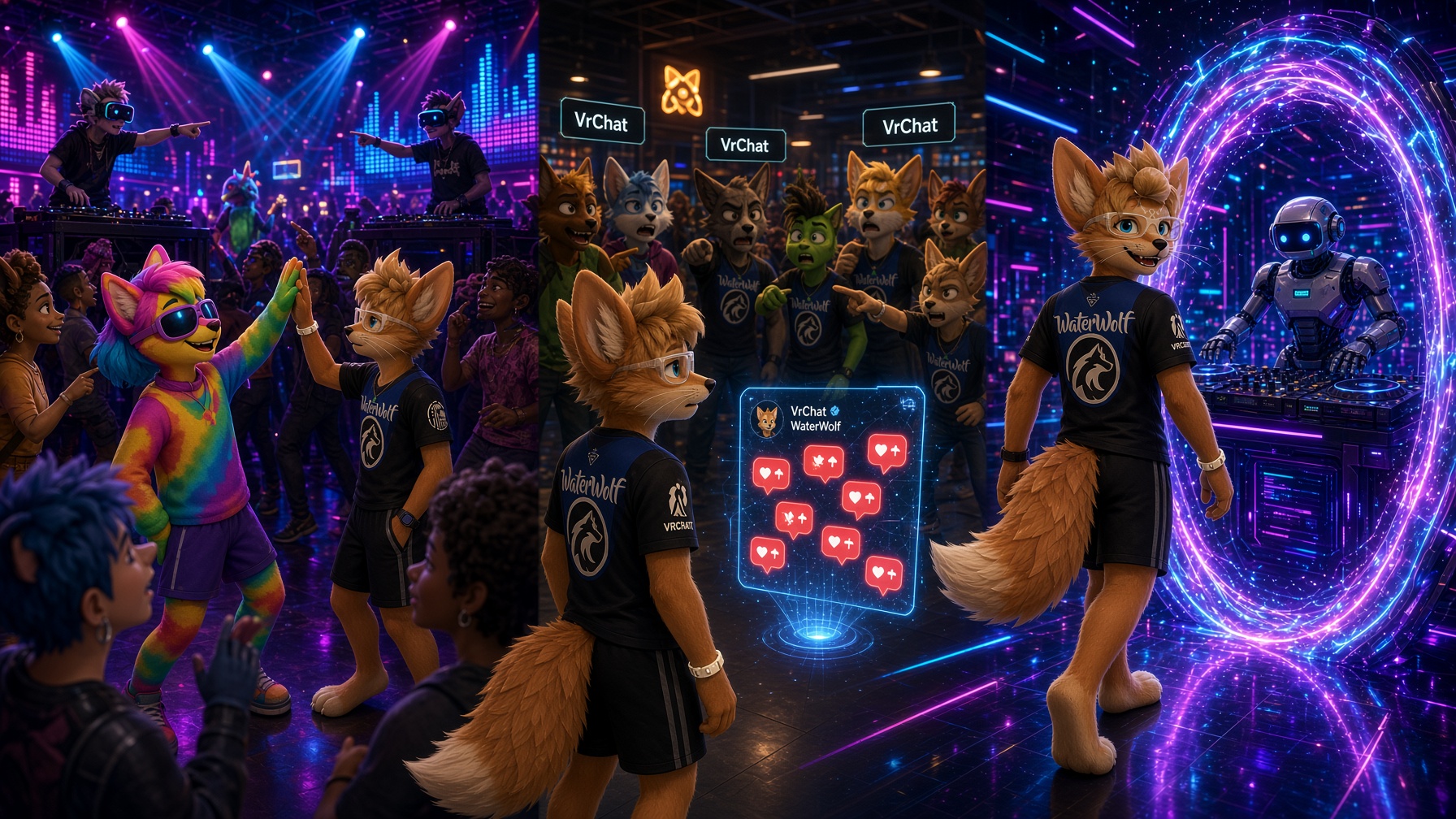
VRChat gave me some of the greatest experiences of my life. It also introduced me to a culture of social manipulation, manufactured outrage, and people willing to hurt others for a little attention.
There is something extraordinary about VRChat. It's a place where people from different countries, backgrounds, and walks of life can come together to create things that would otherwise be impossible. Musicians can perform for international audiences. Artists can build entire worlds. Engineers can develop experiences that connect thousands of people. Friendships can form across distances that would have made them impossible just a generation ago.
I've spent years of my life contributing to that environment. I've built communities, developed infrastructure, organized experiences, and invested considerable time and money into making VRChat a better place for the people around me.
Some of the happiest moments of my life happened here.
Unfortunately, so did some of the worst.
And after years of watching the same destructive behaviors repeat themselves, I think it's time we had a much more uncomfortable conversation about the people who exploit VRChat's social environment for attention, influence, and personal gratification.
When Entertainment Becomes a Competition for Power
VRChat's nightlife community is one of its most impressive accomplishments. The fact that people can organize virtual concerts, operate elaborate nightclubs, and bring audiences together around music is genuinely remarkable.
But somewhere within that culture, entertainment can become secondary to social competition.
I've watched DJs and organizers become consumed by popularity, influence, and the perceived importance of their own social circles. I've seen disagreements become personal vendettas, friendships become political alliances, and communities become territories that people believe they must defend.
The music stops being the point.
Instead, it's about who has the bigger audience, who controls the guest list, who gets invited to which event, and who has enough influence to make somebody else unwelcome.
And when that influence becomes a weapon, the consequences extend far beyond a virtual nightclub.
Behind every avatar is an actual human being. Someone with responsibilities, relationships, personal struggles, and a life outside the headset.
Yet some people behave as though the virtual environment absolves them of responsibility for how they treat others.
Being a DJ doesn't make you royalty. Having followers doesn't make you morally superior. And organizing a virtual event certainly doesn't give you the right to treat other human beings as disposable.
The Business of Manufacturing Outrage
One of the most exhausting behaviors I've encountered is the willingness to manufacture public controversy out of relatively minor interactions.
I've experienced situations where someone approached me, initiated an interaction I considered deliberately condescending, and then publicly complained when I responded.
In one instance, someone approached me while I was minding my own business and patted my avatar on the head. I interpreted the gesture as an attempt to belittle me.
Curious about how they would react, I sent them an invitation to my community.
The response was almost immediate. They took to Bluesky to express outrage over receiving the invitation.
What fascinated me wasn't simply the complaint. It was how the public discussion focused on my response while disregarding the interaction that preceded it.
Now, someone else might interpret that head pat differently. And I recognize that my invitation was deliberate. But those details are precisely why context matters.
If we're going to publicly criticize someone's behavior, shouldn't we be willing to explain the entire interaction?
Instead, social media makes it remarkably easy to present a carefully selected fragment of an encounter and invite an audience to become angry on your behalf.
The original incident becomes almost irrelevant.
The outrage becomes the product.
The Audience That Rewards Destruction
There is a particularly troubling incentive structure in online communities.
Someone makes an accusation. Their followers rally behind them. Other people join the discussion, often without knowing the individuals involved or understanding the history of the disagreement.
Before long, a relatively small interpersonal conflict becomes a public spectacle.
The person at the center receives attention, engagement, and social reinforcement.
And the audience receives entertainment.
But what happens to the person being discussed?
What happens when their reputation becomes the subject of a public performance? When people who have never spoken to them begin making assumptions about their character? When every attempt to explain themselves creates another opportunity for someone to extract a provocative screenshot?
The internet has become exceptionally good at rewarding people for being angry.
It is considerably worse at rewarding people for being accurate.
And within tightly connected VRChat communities, where reputations travel quickly and social circles overlap, the consequences can be substantial.
We should be far more skeptical of people who repeatedly find themselves at the center of public controversies, particularly when those controversies consistently generate attention at somebody else's expense.
That doesn't mean every accusation is false. It means public outrage should never substitute for evidence, context, and proportion.
When Community Leadership Becomes Social Control
I created Waterwolf because I wanted to build something.
I wanted to bring people together, develop interesting experiences, and give others opportunities to enjoy the things I was creating.
I never imagined that doing so would eventually involve navigating so many interpersonal power struggles.
Over time, I encountered people who appeared to believe that contributing to a community entitled them to control its direction. Others seemed to believe that enjoying something I created gave them authority over what I should do next.
Decisions about technology, events, creative direction, and community organization increasingly became entangled with people's personal expectations.
And when those expectations weren't satisfied, the disagreements sometimes became deeply personal.
I've experienced damaged friendships, public hostility, and situations that made me question whether the effort I was investing was worth the consequences.
There is a fundamental difference between participating in a community and believing you own the people who make that community possible.
Volunteers are not employees. Friendships are not contracts. Generosity is not an unlimited resource.
And creators should not have to surrender their independence simply because other people have become accustomed to benefiting from their work.
The Human Cost Nobody Wants to Discuss
Perhaps the most disturbing part of this culture is how casually some people treat the emotional and reputational consequences of their actions.
It's easy to dismiss a controversy as VRChat drama.
It's just a video game, right?
Except it isn't just a video game when people have invested years into building relationships and communities.
It isn't just a video game when someone becomes the target of persistent hostility.
It isn't just a video game when friendships collapse, reputations are damaged, or people begin carrying the stress of online conflicts into their everyday lives.
I've experienced enough of this to know that the consequences can be real.
And I find it particularly difficult to respect people who appear to enjoy creating those consequences.
There is nothing impressive about provoking someone until they react and then presenting their reaction as proof that they're the problem.
There is nothing admirable about gathering an audience to ridicule someone.
And there is certainly nothing courageous about using social popularity to intimidate people who lack the same influence.
That's not leadership.
That's cruelty dressed up as community participation.
Popularity Is Not Character
One of the most important lessons I've learned is that popularity tells you remarkably little about someone's character.
A person can be an excellent DJ and a terrible friend.
They can organize spectacular events while treating people around them poorly.
They can speak endlessly about kindness, inclusion, and community while behaving very differently toward people they dislike.
None of those contradictions are unique to VRChat. They're human problems.
But virtual communities can amplify them because social status is so visible and because there are relatively few barriers between an interpersonal disagreement and a public audience.
We need to stop assuming that the loudest, most recognizable, or most socially connected people are automatically the ones worth listening to.
Judge people by how they behave when there's nothing to gain.
Watch how they treat people who disagree with them.
Pay attention to whether they can resolve conflicts privately, admit mistakes, and allow others to move on.
Those things tell you far more about someone's character than a crowded nightclub or a large follower count.
I Still Believe in VRChat
Despite everything I've written, I haven't lost my appreciation for what VRChat makes possible.
I still believe in its creators, its engineers, its musicians, its artists, and the countless people who log in simply to enjoy themselves.
I still believe that communities can accomplish extraordinary things when people work together.
And I still want to build.
What has changed is my willingness to participate in the endless cycles of social competition that seem to consume certain corners of this platform.
I don't want to spend my time fighting over audiences, defending imaginary territory, or participating in public campaigns against people who happen to disagree with me.
I want to make things.
I want to enjoy the company of people who appreciate those things.
And I want the freedom to walk away from something when it stops bringing me joy.
That shouldn't be controversial.
A Community Worth Building
I don't expect VRChat to become a place without disagreements. People are complicated, personalities clash, and even well-intentioned individuals make mistakes.
But we should be capable of recognizing the difference between ordinary conflict and behavior that is deliberately destructive.
We should be willing to challenge people who use popularity as leverage, manufacture outrage for engagement, or treat other people's reputations as disposable entertainment.
And we should stop confusing social influence with moral authority.
If you're a DJ, play music that people love.
If you're an organizer, create experiences people want to attend.
If you're an artist, make something extraordinary.
If you're a community leader, remember that the people around you are human beings, not resources to be controlled.
And if your primary contribution to VRChat is provoking people, humiliating them, and turning their frustration into content for your followers, perhaps it's worth asking what you're actually contributing.
I've spent years building things for people in VRChat. I've made mistakes, I've learned difficult lessons, and I've had to reconsider what I want from the communities I participate in.
But one thing I refuse to accept is the idea that cruelty becomes acceptable simply because it's entertaining.
VRChat has been one of the best things that ever happened to me.
It has also been one of the worst.
I intend to carry forward the creativity, friendships, and experiences that made it worthwhile.
As for the destructive social games, the manufactured outrage, and the people who seem to thrive on making others miserable?
They can keep playing those games without me.
I have better things to build.
Comments