
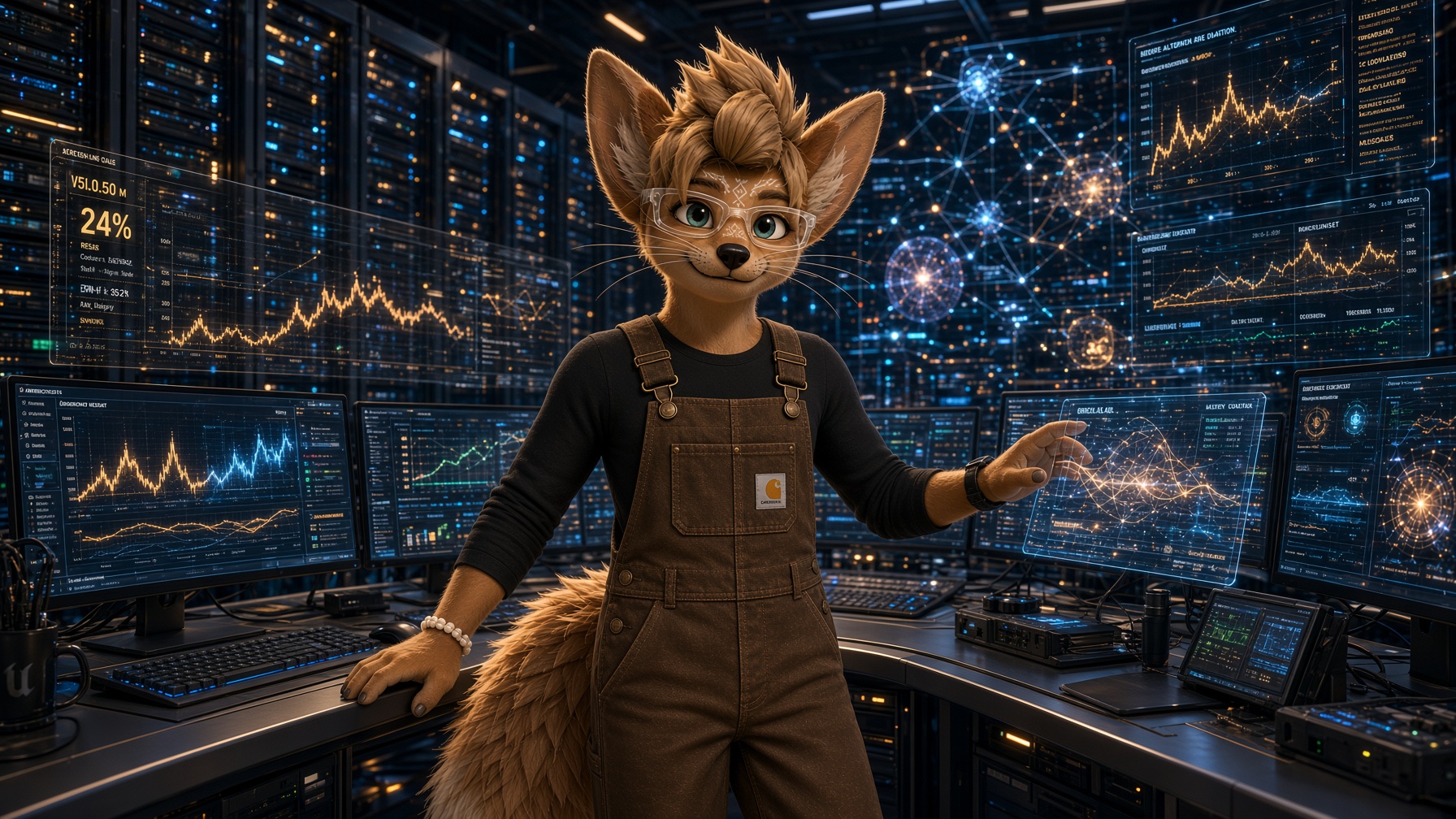
How two years of frustration, mountains of code, and a little vengeance taught me to see the future of online communities.
I used to just want to build worlds.
Keep my head down, make clubs, make spaces people loved.
It was that simple.
I wanted to create places where people could gather, enjoy themselves, listen to music, make friends, and experience something wonderful together.
I wasn't asking for much.
I wasn't trying to control anyone else's community. I wasn't interested in competing for some imaginary throne.
I wanted to build things, and I wanted to be left alone to enjoy them.
All you really had to do was avoid me.
But apparently, even that was too much to ask.
Someone decided to make that simple thing difficult.
What should have been a creative outlet became an exhausting exercise in navigating other people's anger, arrogance, entitlement, and resentment.
And eventually, something changed.
I stopped building clubs.
Instead, I buried myself in code.
And I got very, very good at it.
Mountains of Spite Code
I didn't set out to build dashboards or predict people.
I set out to make nights feel alive.
But when that door closed, I kept building anyway.
Line after line. Night after night. Project after project.
Mountains of code.
And I mean mountains of it.
Some of the most elaborate systems I've ever designed came from one incredibly simple source of motivation:
Spite.
For almost two years, the anger, arrogance, and sheer stupidity of one particularly irritating bird became an almost unlimited source of creative fuel.
Every time I encountered another unnecessary obstacle, I found something else to build.
Every time someone insisted something couldn't be done, I found a way to do it.
And every time someone tried to convince me that I wasn't capable of creating something worthwhile, I became a little more determined to prove otherwise.
Not through arguments.
Through results.
I started learning more about programming, artificial intelligence, statistical analysis, market behavior, predictive modeling, and the mathematics behind understanding trends.
I became fascinated with how enormous quantities of seemingly unrelated information could reveal patterns that weren't immediately obvious.
The same techniques used to analyze stock markets, measure business performance, and forecast economic behavior could be applied to entirely different environments.
And somewhere along the way, I realized something extraordinary.
I wasn't just building software anymore. I was building a way to understand what was happening around me.
The irony is almost beautiful.
Someone tried to make my little corner of the internet miserable, and in doing so, gave me the motivation to build something far more powerful than another nightclub.
I suppose I should thank him.
Different Clubs. Different People. The Same Damn Story.
For the longest time, I genuinely believed the problems I was experiencing were unique.
I thought perhaps there was something particularly unusual about the people around me, the communities I participated in, or the circumstances surrounding my own experiences.
Then I started looking at the bigger picture.
And I discovered something fascinating.
It wasn't just happening to me. It was happening everywhere.
Different communities.
Different clubs.
Different personalities.
Different arguments.
But underneath all those differences, the same fundamental stories kept repeating themselves.
Someone builds something successful.
Someone else decides they deserve a piece of that success.
Perhaps they believe they're entitled to recognition they never earned. Perhaps they're frustrated that someone else accomplished something they couldn't. Perhaps their ego simply cannot tolerate watching another person succeed without their involvement.
And when they can't obtain what they believe they're owed, the behavior changes.
Admiration becomes resentment.
Resentment becomes jealousy.
Jealousy becomes hostility.
And eventually, hostility becomes an attempt to undermine, shame, discredit, or destroy whatever triggered those feelings in the first place.
Sometimes the motivation is different.
Someone experiences rejection. Someone loses influence. Someone's pride gets wounded.
Rather than accepting what happened and moving forward, they become consumed with proving that the other person deserves to suffer.
I recognize that feeling.
After all, I spent almost two years using my own frustration as motivation.
The difference is what I chose to do with it.
I built things.
I turned my anger into software, infrastructure, programming knowledge, and increasingly sophisticated systems.
Other people sometimes choose to turn those same feelings into destruction.
And that's where things started getting interesting.
Because although the people and circumstances were different, the broader patterns looked remarkably familiar.
Human Behavior Has Patterns. And Patterns Can Be Measured.
When you look at a stock market, you're not necessarily interested in every individual investor.
You're interested in the movement.
The trends.
The volume.
The peaks.
The sudden changes in direction.
You look at historical behavior, compare it against current conditions, and attempt to understand what might happen next.
You don't need to know every private conversation happening inside a corporation to recognize that something unusual is happening to its stock.
You look at the data.
And I started wondering whether a similar approach could reveal something useful about online communities.
What happens to attendance when a community experiences conflict?
How does participation change when a successful event attracts attention?
What does a healthy community look like compared with one experiencing a sustained decline?
How do different groups recover from disruptions?
What happens when a popular club closes?
Where do people go?
When do communities experience their greatest participation?
And perhaps most interestingly, are there recognizable patterns that precede major changes?
These questions led me deeper into statistics, historical comparisons, predictive models, and increasingly elaborate analytical systems.
I started examining how the same kinds of measurements used to understand markets could help explain the behavior of online social environments.
And I discovered that many apparently chaotic situations become considerably easier to understand when viewed through enough historical information.
An argument might feel spontaneous to the people participating in it.
A sudden decline in attendance might seem mysterious.
A community's explosive growth might appear completely unexpected.
But when you start comparing the broader patterns, you can sometimes identify changes that began long before the eventual outcome became obvious.
Not every pattern proves a particular motive. A chart cannot tell me with certainty that someone is jealous, malicious, or entitled.
But it can reveal changes in participation, momentum, and community health that deserve attention.
And the more information I learned to interpret, the more confident I became in recognizing those changes.
I Accidentally Built a Time Machine
Here's where the story gets particularly amusing.
I think I accidentally built a time machine.
Not a literal one, obviously.
I can't travel backward and prevent someone from making a stupid decision.
Although I admit that would be entertaining.
What I've developed is something that can sometimes see a little farther ahead than ordinary observation allows.
A system built around historical information, statistical relationships, automated analysis, and increasingly sophisticated technology.
Technology supported by computing infrastructure that would have been unimaginable to me when I was simply trying to build another VRChat nightclub.
I have spent an extraordinary amount of time learning how to collect information, compile it, analyze it, and identify meaningful relationships.
I've explored the capabilities of some of the most sophisticated AI systems and computing resources available to me.
And the results have been fascinating.
Situations that once caught me completely by surprise now sometimes follow trajectories I recognize.
I can watch changes unfold and compare them against patterns I've already studied.
I can develop expectations about where something might be heading, then observe whether subsequent events support those expectations.
And a surprising number of those expectations have aligned with what eventually happened.
That doesn't mean the system is infallible.
Prediction is not certainty, and no amount of statistical sophistication eliminates the possibility of being wrong.
But the practical difference in how I understand the world around me has been enormous.
I used to react to events after they happened. Now I can sometimes recognize the conditions that precede them.
That changes how you approach almost everything.
It changes how you allocate your time.
It changes which problems deserve your attention.
It changes how you evaluate the health of a community.
And perhaps most importantly, it changes how confidently you can make decisions.
The Confidence That Comes From Understanding
Something interesting happened as I became more comfortable working with these systems.
I became considerably more confident.
Not necessarily louder.
Not necessarily more confrontational.
Just more deliberate.
I started recognizing that I didn't have to respond to every accusation, every provocation, or every manufactured controversy as though it were an unprecedented emergency.
I'd seen similar situations before.
I'd watched comparable patterns unfold elsewhere.
I'd studied how communities responded, how participation changed, and how circumstances developed over time.
That perspective made me more situationally aware.
And it made my decisions more calculated.
I don't have to guess blindly about every situation anymore.
I can examine what information is available, compare it against historical patterns, and make a more informed judgment about what deserves my attention.
Sometimes that means acting quickly.
Sometimes that means recognizing that a situation is unlikely to develop into anything significant.
Sometimes it means identifying an opportunity that other people haven't noticed yet.
And sometimes it means watching someone confidently repeat a mistake I've already seen play out a dozen times.
There's something almost comical about that last one.
Because the person making the mistake often believes they're doing something completely original.
Meanwhile, I'm looking at another variation of a very familiar story.
Different server.
Different mascot.
Same script.
And Here's the Best Part: I'm Sharing It.
I could have kept everything to myself.
I could have treated this knowledge as some closely guarded competitive advantage.
I could have used it exclusively to improve my own projects, understand my own communities, and make my own decisions.
But that would have missed the entire point of what I learned.
The problems I encountered weren't unique to me.
And the tools that helped me understand them shouldn't have to be unique to me either.
So I've been developing ways to make useful analytical information available to other people.
The idea is straightforward.
If someone wants to understand their own participation and activity, they should be able to voluntarily connect their profile and access the information available about themselves.
If a group wants to understand its performance, it should be able to verify its ownership and access useful metrics about its community.
Imagine being able to understand when your club experiences its highest attendance.
Which nights consistently perform best.
Which starting times attract the strongest participation.
How your events compare across weeks or months.
Whether your community is growing, declining, or remaining stable.
How different scheduling decisions influence participation.
And whether your assumptions about your community's success actually match measurable results.
These are the kinds of questions that businesses spend enormous amounts of money trying to answer.
Yet many volunteer-run communities are expected to make the same decisions with little more than intuition.
I think we can do better.
And I think the technology should be accessible to the people actually doing the work.
Privacy Is Not Optional
There's an important distinction here.
I am not interested in building a surveillance system.
I do not track the identities of people inside individual VRChat instances, and I do not perform individual attendance tracking.
That is not what this project is about.
I operate within the VRChat platform rules and compliance requirements communicated to me, and I design these systems around those boundaries.
Where personal information or account-specific functionality is involved, participation is voluntary and based on consent.
Groups can choose whether to verify themselves and participate.
Individuals can choose whether to connect their own profiles.
The purpose is to understand aggregate trends and community performance, not to secretly monitor people's private social lives.
You don't need to know who someone is sitting beside to understand whether a nightclub is successful.
You don't need to know what people are saying privately to identify that an event consistently attracts more visitors on Friday than on Tuesday.
And you certainly don't need to violate someone's privacy to understand whether a community is growing.
The information that matters can often be found in the broader patterns.
That's where I want the technology focused.
Because the objective isn't to give people more control over one another.
It's to give them better control over their own decisions.
The Most Expensive Revenge Is Sometimes the Most Productive
I find myself returning to the beginning of this story.
Almost two years ago, I just wanted to build clubs.
That's it.
I wanted to create beautiful spaces, put on music, invite my friends, and enjoy the things we made together.
Someone made that unnecessarily difficult.
And for a long time, I carried an enormous amount of frustration about it.
I still remember it.
I haven't forgotten the arrogance.
I haven't forgotten the attempts to shame me.
And I certainly haven't forgotten the absurdity of watching people turn something as simple as building virtual nightclubs into a personal battlefield.
But look at what happened.
I learned to program at a level I hadn't previously imagined.
I developed increasingly sophisticated infrastructure.
I explored statistical analysis, predictive modeling, artificial intelligence, and the mechanics of community participation.
I built systems that can help other people understand their own projects.
I gained a much broader understanding of how online communities operate.
And I developed the confidence to make decisions based on something more substantial than whichever person happened to be shouting the loudest.
All because somebody couldn't leave me alone.
You wanted to make building clubs difficult for me. Instead, you motivated me to build the tools that help people understand how clubs succeed.
There's a certain poetry to that.
You tried to take away something I loved.
And in the process, you accidentally pushed me toward something much bigger.
I didn't become less capable.
I became considerably more capable.
I didn't stop creating.
I expanded what I was capable of creating.
And I didn't disappear.
I simply started building things you couldn't see.
I Still Have Fangs
There's one thing I don't want anyone to misunderstand about any of this.
I haven't become a different person.
Underneath all the programming, statistics, infrastructure, and increasingly elaborate technology, I'm still the same little fox who wanted to make beautiful places for his friends.
I still enjoy being kind.
I still enjoy making people happy.
I still want to open doors, create opportunities, and give people spaces where they can feel welcome.
I don't particularly enjoy fighting.
I don't wake up looking for someone to argue with.
And despite everything I've experienced, I still believe there's tremendous value in being gentle with people.
But gentleness should never be confused with helplessness.
Kindness is not an admission of weakness.
And being sweet doesn't mean I'm incapable of recognizing when someone is trying to take advantage of me.
I can have a soft heart and a sharp mind.
I can welcome people into my spaces while maintaining boundaries around what I've created.
I can forgive someone without pretending their actions never happened.
And I can be perfectly pleasant while remaining fully aware of what's happening around me.
The difference between who I was two years ago and who I am today isn't that I've become colder.
It's that I've become more capable.
More knowledgeable.
More deliberate.
And considerably harder to intimidate.
I didn't lose my kindness.
I learned how to protect it.
I didn't lose my desire to create.
I discovered how much more I could build.
And I didn't lose my fangs.
I simply learned that I don't have to show them every time someone tries to provoke me.
The Fox Who Learned to See the Storm
There's something wonderfully ironic about everything that has happened.
The people who made me feel unwelcome in the spaces I loved probably imagined they were diminishing my influence.
Instead, they gave me a reason to learn how influence works.
They gave me a reason to study the patterns behind community success and failure.
They gave me a reason to build technology that could help other creators avoid some of the same frustrations.
And they gave me nearly two years of motivation to become extraordinarily good at something I might never have pursued this deeply otherwise.
I still want to build worlds.
I still want to make clubs.
I still want to create places where people can laugh, dance, and forget about the ridiculous conflicts that consume so much of the internet.
But now I can do something else, too.
I can help people understand the environments they're building.
I can help them recognize opportunities.
I can give them tools to make better decisions.
And when the next storm begins forming, I might recognize its shape before the rain arrives.
Not because I control the future.
But because I've spent an extraordinary amount of time learning from the past.
So, to the people who thought they were taking something away from me:
Look at what you helped create.
You didn't destroy my creativity.
You redirected it.
You didn't make me powerless.
You motivated me to become more capable than I ever expected.
And you certainly didn't teach me to be afraid.
You taught me to pay attention.
I'm still that sweet little fox who wants nothing more than to build beautiful things and share them with the people he loves.
The difference is that now I understand the storm, I know how to build through it, and I can sometimes see it coming.
My heart is still soft. My door is still open. And my fangs are exactly where they've always been.
Never mistake my kindness for an inability to bite.
And never mistake my silence for an inability to see.
---
Love, your friend Isaac.
I hope you have a beautiful day, buddy.
Comments